
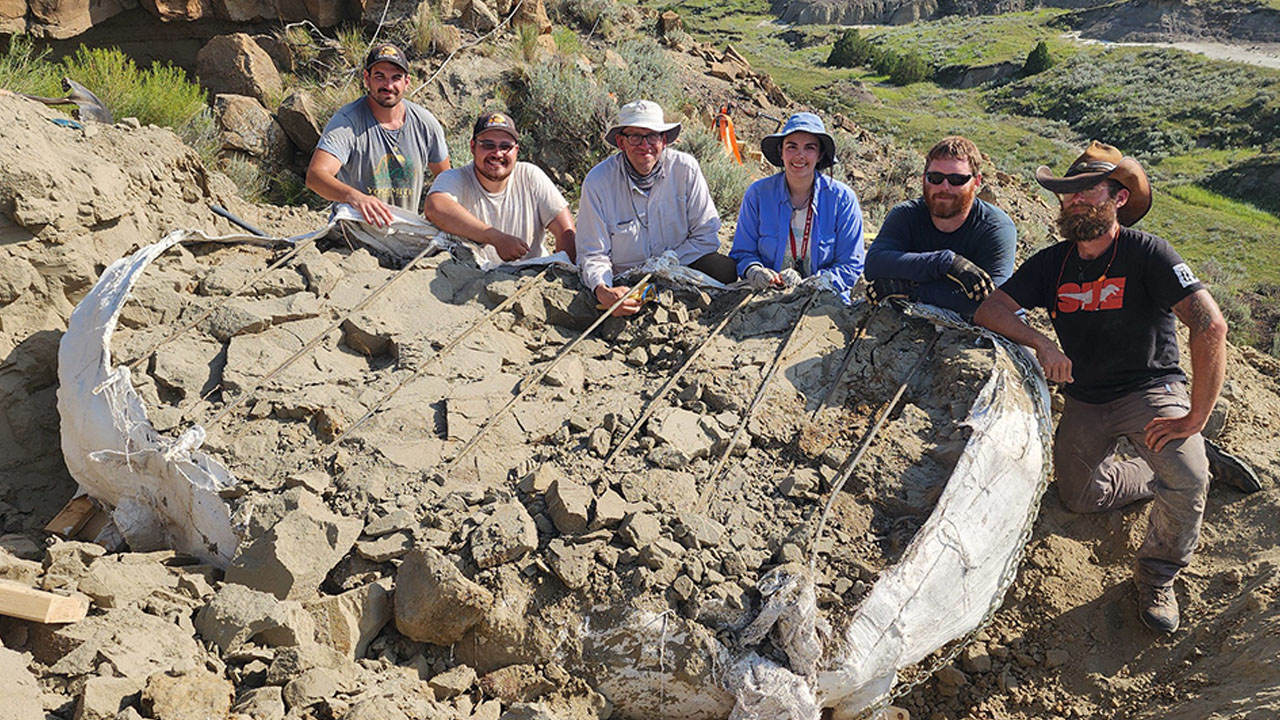
Winona State University has installed potentially one of the rarest dinosaur fossils ever discovered — a 66-million-year-old Edmontosaurus unearthed in the badlands of southwestern North Dakota. The fossil, now secured on campus, may be a “dinosaur mummy,” meaning it could preserve skin and other soft tissues that are almost never found in fossils.
The specimen arrived encased in a massive plaster jacket measuring approximately 12 feet long and 7 feet wide. Faculty, alumni, and students worked together to position the fossil in its new home, marking the beginning of a long and meticulous process of preparation and conservation.
“This is an extraordinary moment for Winona State and for science,” said Dr. Lee Beatty, Professor and Chair of the Geoscience Department. “Only a handful of dinosaur mummies have ever been discovered worldwide. If this fossil contains preserved skin and soft tissues, it could provide unprecedented insights into dinosaur biology, evolution, and appearance — things skeletons alone can’t tell us.”
The fossil was discovered in July 2024 by Adam Schroeder, a 2013 Winona State Geoscience graduate and owner of Hell Creek Fossils, while prospecting on private land near Marmarth, North Dakota. Excavation required hauling tools and materials a mile on foot to the top of a remote butte, where the fossil was encased in a sandstone concretion. The team — including Schroeder, Beatty, and alumni Samantha Khatri (’19) and Brady Bynton (’24) — wrapped the fossil in a protective plaster jacket and transported it out of the badlands using chains, wooden rollers, and a truck.
Photos of the fossil and the excavation site are available for download: https://flic.kr/s/aHBqjCC6gj.
Photos of the arrival and installation are available for download: https://flic.kr/s/aHBqjCC6gj.
The fossil comes from the Hell Creek Formation, a geologic layer dating back 66 million years to the end of the age of dinosaurs. It appears to include articulated limbs and vertebrae, though the head and most of the tail are missing. Based on other Edmontosaurus specimens, researchers estimate the animal was 20–25 feet long when alive.
Now that the fossil is installed, Winona State faculty and students will begin the painstaking process of removing the surrounding sandstone and studying the specimen. Ultimately, the fossil will be displayed on campus for students, researchers, and the public.
“This discovery is not just about science — it’s about education and opportunity,” Beatty said. “Our students will gain hands-on experience in fossil preparation and research, and the community will have a chance to engage with a piece of Earth’s history.”
Fast Facts
Species: Edmontosaurus (herbivorous “duck-billed” dinosaur)
Age: Approximately 66 million years old
Size: Fossil jacket measures 12 feet by 7 feet; estimated original length 20–25 feet
Origin: Hell Creek Formation, southwestern North Dakota
Significance: Possible “dinosaur mummy” with preserved skin and soft tissues; fewer than a dozen such specimens exist worldwide
About Winona State University
Founded in 1858, Winona State University is a comprehensive, regional public university with campuses in Winona and Rochester. The oldest member of the Minnesota State system, WSU offers more than 80 undergraduate, pre-professional, licensure, graduate and doctorate programs in five colleges: Business, Education, Liberal Arts, Nursing & Health Sciences, and Science & Engineering.
Winona State is ranked 2nd among Minnesota Universities and 22nd across the entire Midwest region (U.S. News and World Report, 2025-26). It has been named among the “Best in the Midwest” by The Princeton Review for 22 consecutive years.
The University generates $447.9 million in economic impact for the region per year. The university’s mission is to enhance the intellectual, social, cultural and economic vitality of the people and communities it serves: a community of learners improving our world. For more information, visit winona.edu.
